Khatian not found on Banglarbhumi — what it actually means
An empty result almost never means the land has no record. It usually means the search was pointed at the wrong Mouza, the wrong record generation, or the wrong Dag number.
- Guide
- Diagnosing
- Read
- 9 min
- Language
- English · বাংলা
Portal steps checked against banglarbhumi.gov.in on
Devikon Research Team
An empty result is a search problem, not a land problem
Banglarbhumi's search does not tell you why it found nothing. It returns a blank table, and people reasonably conclude their land is missing from government records. In the great majority of cases it isn't — the search simply looked in the wrong place.
The portal's lookups — Know Your Property, RS-LR Plot Information and Mouza Information — all query one specific Mouza at a time, in one specific record generation. Get either of those wrong and the correct record sits untouched a few dropdown selections away.
Work through the causes below roughly in order. The first three account for most blank results.
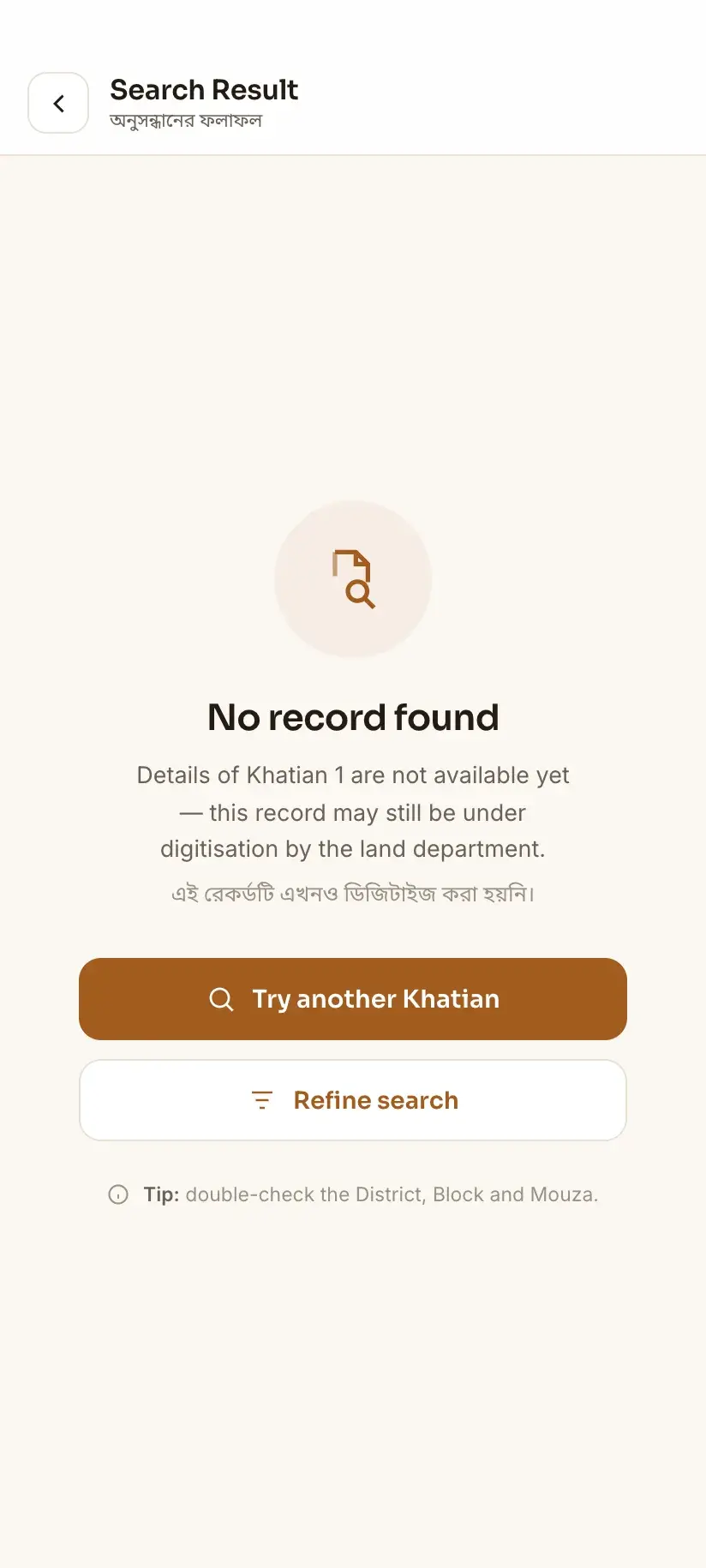
First, rule out the simplest explanation of all: **being sent to a sign-in screen is not an empty result.** You need to be signed in to a banglarbhumi.gov.in account before the portal returns a record, and it does not tell you so until the last step — the District, Block and Mouza dropdowns fill in normally either way. If a search ended at a login form rather than a blank table, sign in and run it again before reading anything below.
Cause 1: the Mouza or JL number is wrong
Khatian and Dag numbers are only unique inside a Mouza, so the whole search depends on having the right one — and Mouza names repeat across West Bengal far more than people expect. The JL number is what tells two similarly named Mouzas apart.
Find it on any older document you hold — a parcha, deed, rent receipt or mutation order — usually printed alongside the Mouza name. The portal's Mouza Information service lists Mouzas with their JL numbers for a chosen District and Block. What a Mouza and JL number are explains the hierarchy in full.
- Confirm the District and Block first — a wrong Block silently restricts the Mouza list to the wrong set entirely
- Match the JL number, not the spelling of the Mouza name
- If your document predates a district reorganisation, the Block name on it may no longer exist; the JL number usually survives the change
Cause 2: you're searching RS when the record is LR (or the reverse)
West Bengal has more than one generation of survey records, and they do not share Khatian or Dag numbering. A number taken from an RS parcha will very often return nothing against LR records — the record exists, but the number does not mean the same thing in the other generation.
If you don't know which generation your document belongs to, search both. It costs two minutes and resolves a large share of blank results. For what the two generations actually are and which one to quote, see RS vs LR khatian.
Do not assume the newer record is the correct one to quote. Which generation applies to your land depends on which settlement operation was completed and published in that Mouza, and that varies across the state.
Cause 3: sabek dag vs hal dag
The same distinction bites hardest on plot numbers. Sabek dag is the older plot number; hal dag is the current one after resurvey, and the two do not map neatly onto each other.
A sabek number entered into a hal-dag search returns nothing — and, more dangerously, can coincidentally match a real but unrelated hal dag. A result with an owner name you don't recognise is a signal to check which numbering you used, not evidence that someone else holds your land.
Older deeds and inherited parchas overwhelmingly carry sabek numbers. If your paperwork is old, assume sabek until confirmed. How to match sabek to hal covers the techniques people actually use.
Cause 4: name spelling, in Bengali and in English
Searching by owner name is the least reliable route on the portal, and it is worth understanding why before you conclude a record is missing.
Records were digitised from handwritten registers, so the stored spelling is whatever the operator read, and Bengali names transliterate into English several different ways. The record may hold a form you would never think to type.
Where the search accepts Bengali, entering the name in Bengali skips the transliteration problem entirely. Even then, a partial name usually returns more than an exact full one. Searching a Khatian online goes through the search itself in detail.
- Search by Khatian or Dag number wherever you can — numbers survive digitisation far better than names
- Try the surname alone before the full name
- Try both Bengali and English spellings of the same name
- Check whether the record is in an ancestor's name — inherited land often remains unmutated for decades
Cause 5: the record genuinely isn't online yet
Digitisation coverage is not uniform. Some Mouzas were digitised early and completely; others have gaps, particularly where registers were damaged, where a settlement operation is still in progress, or where the land sits in an area that has been through boundary reorganisation.
There is a second, more common variant of this: the record exists in the department's files but has not been updated online because a case is still pending. If a mutation (Dakhil Kharij) has been applied for but not disposed of, the Khatian will still show the previous holder — or, if the mutation created a new Khatian, that new Khatian may not yet be published. Mutation Case Status on the portal will tell you where the application has actually reached.
Both situations have the same remedy, and it is not more searching. It is the BL&LRO office.
When to stop searching and go to the BL&LRO
Go to your Block Land & Land Reforms Office once you have confirmed the District, Block, Mouza and JL number are correct, tried both RS and LR, and tried both sabek and hal dag numbers. Further online attempts past that point rarely produce anything.
The BL&LRO holds the authoritative record and can tell you which of three situations you are in: the record exists and the online copy is stale, the record exists but was never digitised, or the record carries an error that needs correction. Only the office can start a correction, and corrections to a published record are handled through an application there, not through the portal's record search.
Take everything you have. The strength of your case depends almost entirely on the documents you bring.
- Any parcha, ROR or Khatian copy you hold, however old
- The registered deed, and the deed of the person you bought from if you have it
- Rent (khajna) receipts — a continuous run of these is strong evidence of possession
- Mutation or conversion orders, and the case number of anything still pending
- An identity document, and a succession or Warish certificate if the claim is inherited
Ask the office to write down the Mouza's JL number and the correct record generation for your land. Having those two facts confirmed on paper makes every future online search work first time.
Procedure
How to rule out a search error before assuming the record is missing
Roughly ten minutes on the portal, signed in to your Banglarbhumi account throughout — the searches will not return anything otherwise.
Find the JL number on your own paperwork
Look on any parcha, deed, mutation order or rent receipt for the Mouza name and its JL number. Write both down before you open the portal.
Sign in and open the search
Go to banglarbhumi.gov.in, sign in to your account, then choose Know Your Property — or RS-LR Plot Information if you are searching by plot number. Signing in first matters here: a search run signed out ends at the login page rather than at a result, which is easy to mistake for a record that isn't there.
Select District, Block and Mouza in that order
Check the Mouza against your JL number rather than against the spelling of its name. If two Mouzas look alike, the JL number is the decider — Mouza Information lists them for a chosen Block.
Search by Khatian number in one record generation
Enter the Khatian number and search. If it returns nothing, switch between RS and LR and search again with the same number.
Repeat with the plot number, both sabek and hal
Search by Dag number instead. Try it as a hal dag and as a sabek dag — a document more than about twenty years old most likely carries the sabek number.
Check for a pending case
If nothing matches, open Mutation Case Status and search any application number you have. A pending mutation explains a Khatian that still shows the previous holder, or one that has not yet appeared.
Take it to the BL&LRO
If all of the above come back empty, the record needs the office rather than the portal. Bring your parcha, deed, rent receipts and any pending case numbers to your Block Land & Land Reforms Office.
Frequently asked questions
- Why does Banglarbhumi show no record for my Khatian number?
- Usually because the search is pointed at the wrong Mouza or the wrong record generation. Khatian numbers are only unique within a Mouza, and Mouza names repeat across West Bengal — check the JL number rather than the spelling. Also try the same number against both RS and LR records, since LR re-numbered Khatians during its own survey and an RS number will not match.
- What is a JL number and where do I find mine?
- JL stands for Jurisdiction List. It is the number that uniquely identifies a Mouza within its police station (thana) area — which is why official notices always quote the P.S. alongside it, and it is what distinguishes two Mouzas with similar names. It is normally printed next to the Mouza name on a parcha, deed, mutation order or rent receipt. The portal's Mouza Information service also lists Mouzas with their JL numbers for a chosen District and Block.
- My Dag number returns nothing. Is it a sabek number?
- Sabek dag is the older plot number and hal dag is the current one after resurvey. They do not correspond one to one — a single sabek dag is often split across several hal dags, or several merged into one. Entering a sabek number into a hal-dag search returns nothing, and can occasionally return an unrelated plot that happens to share the number. Documents more than roughly two decades old usually carry sabek numbers.
- Should I search RS or LR records?
- Search both if you are unsure. RS (Revisional Settlement, also written Revisional Survey) and LR (Land Reforms) are different survey generations with different Khatian and Dag numbering, and which one applies to your land depends on which settlement operation was completed in that Mouza. The portal's RS-LR Plot Information covers both, and Know Your Property asks you to choose one.
- My land is not online at all. Does that mean I have lost it?
- No. Digitisation coverage is uneven, and a record can also be absent online because a mutation case is still pending. What the record shows and what your title is are separate questions — take your documents to the BL&LRO, and to an advocate who does land title work if anything is contested. Take your parcha, deed and rent receipts to your Block Land & Land Reforms Office — they hold the authoritative record and can start a correction if one is needed.
- Can I get a Khatian record corrected online?
- No. The portal's searches only display records; they cannot change them. Correcting an error in a published record is an application made at the BL&LRO office, supported by your documents. The portal does let you apply online for related services such as mutation and conversion, and those carry fees on top of the banglarbhumi.gov.in account you already need for a lookup.
In Bengali
খতিয়ান পাওয়া যাচ্ছে না — বাংলায়
পশ্চিমবঙ্গের বাংলারভূমি পোর্টালে খতিয়ান সার্চ করে কিছুই আসছে না? বেশিরভাগ ক্ষেত্রে জমির রেকর্ড হারায়নি — ভুল মৌজা, ভুল JL নম্বর বা ভুল দাগ নম্বরে খোঁজা হচ্ছে।
- JL নম্বর কী, আর সেটা কেন দরকার?
- JL নম্বর (Jurisdiction List) প্রতিটি মৌজার নিজস্ব পরিচয় নম্বর। একই নামের মৌজা পশ্চিমবঙ্গে অনেক আছে, তাই নাম দেখে নয় — JL নম্বর মিলিয়ে মৌজা বাছুন। আপনার পর্চা, দলিল বা খাজনার রসিদে JL নম্বর লেখা থাকে। পোর্টালের ‘Mouza Information’ থেকেও জেলা ও ব্লক বেছে মৌজার তালিকা ও JL নম্বর দেখা যায়।
- সাবেক দাগ আর হাল দাগের পার্থক্য কী?
- সাবেক দাগ হল পুরনো জরিপের দাগ নম্বর, আর হাল দাগ হল নতুন জরিপের পরের নম্বর। নতুন জরিপে একটি সাবেক দাগ ভেঙে কয়েকটি হাল দাগ হতে পারে। পুরনো দলিলে সাধারণত সাবেক দাগ লেখা থাকে, তাই দুটো নম্বর দিয়েই আলাদা করে সার্চ করে দেখুন।
- অনলাইনে খতিয়ান না পেলে কোথায় যাব?
- জেলা, ব্লক, মৌজা ও JL নম্বর মিলিয়ে এবং RS ও LR — দুই রেকর্ডেই খুঁজে দেখার পরেও না পেলে স্থানীয় BL&LRO (ব্লক ভূমি ও ভূমি সংস্কার) অফিসে যান। পর্চা, দলিল, খাজনার রসিদ ও চলতি মিউটেশন কেস নম্বর সঙ্গে নিয়ে যাবেন। রেকর্ড সংশোধনের আবেদন সেখানেই করতে হয়, অনলাইনে সার্চ করে হয় না।
Related guides
- How to search a Khatian online in West Bengal
- How to check mutation (Dakhil Kharij) status online
- Banglarbhumi login not working — what to try
- RS Khatian vs LR Khatian — the difference explained
- Sabek dag to hal dag — matching old and new plot numbers
- Warish application in West Bengal — succession and inherited land
- How to find your Mouza name and JL number
- Filing and tracking a grievance on Banglarbhumi
- Banglarbhumi: what you can check, and how