Dag number explained — what it is and how to read one
The dag number is the most quoted figure in West Bengal land records, and the most often misunderstood. It identifies a plot — but only inside one Mouza.
- Guide
- Concept explainer
- Read
- 7 min
- Language
- English · বাংলা
Portal steps checked against banglarbhumi.gov.in on
Devikon Research Team
What a dag number is
A dag number — also written as plot number — identifies one individual parcel of land as it was drawn and numbered during a survey. Every parcel mapped in a Mouza gets its own dag number, and that number is what ties the written record to a specific shape on the Mouza map.
That last part is the point people miss. A dag is not just an entry in a register; it corresponds to a bounded area on a map. When you look up a dag number you are asking about a specific piece of ground with edges, neighbours, and a measured area.
The number is assigned by a particular survey. Because West Bengal's records were built through successive surveys — CS, then RS, then LR — the same ground can carry different dag numbers in different record generations.
The rule that governs everything: dag numbers are Mouza-scoped
A dag number is only unique within a Mouza. Dag 215 exists in a great many Mouzas across West Bengal, and those are entirely unrelated pieces of land belonging to entirely unrelated people — see Mouza and JL number.
This single fact explains most confusion in land searches. A dag number quoted without its Mouza is not an address — it is an address without a town name. Anyone giving you a plot number and expecting you to find it must also give you the Mouza, and ideally the JL number that identifies that Mouza within its Block.
It follows that the sequence on any portal search is not decorative. District, then Block, then Mouza, then the number. Skip the hierarchy and the number means nothing.
The dangerous failure is not an empty result — it is a result. If you select the wrong Mouza and the number happens to exist there, the portal will confidently show you someone else's land. Always sanity-check the owner name and area against what you expect.
How dag relates to khatian
These two numbers answer different questions, and confusing them is common.
A dag is a piece of land. A khatian is an account — the record of what a particular landholder or set of co-holders holds within that Mouza. So one khatian typically lists several dags, and, where a plot is held jointly or has been divided in the record, one dag can appear under more than one khatian.
In plain terms: dag answers "which land?", khatian answers "whose, and what else do they hold?" If you are trying to understand a holding rather than a single parcel, the khatian is usually the more useful entry point — and searching by khatian is often how people find a plot number they had lost.
- One khatian → many dags. A landholder's account normally covers several plots.
- One dag → possibly several khatians. Jointly held land shows up in more than one account.
- Both are Mouza-scoped. Neither number means anything without the Mouza attached.
- Both can change between surveys. A renumbering exercise reassigns dag numbers and rebuilds khatians.
How to read a plot information result
When a plot lookup returns, you are typically looking at a handful of fields. Each is worth understanding rather than skimming.
- Owner / recorded holder name. This is the name in the record, which is not necessarily the current legal owner. If land was sold or inherited and mutation was never completed, the record still shows the earlier holder.
- Share or share fraction. Where land is held jointly, the record shows each holder's share as a fraction rather than a physically demarcated piece. A half share does not tell you which half — that is what partition determines.
- Area. The measured extent recorded for the plot, in the local unit. Compare it against your documents; a large discrepancy is worth investigating, a small one between survey generations is ordinary.
- Land classification. How the land is recorded — for example agricultural or otherwise. This matters because it governs what may lawfully be done with the plot, and changing it is a formal conversion process, tracked on the portal under Conversion Case Status.
- Khatian number. The account the plot sits under, which is your route to seeing what else the same holder holds.
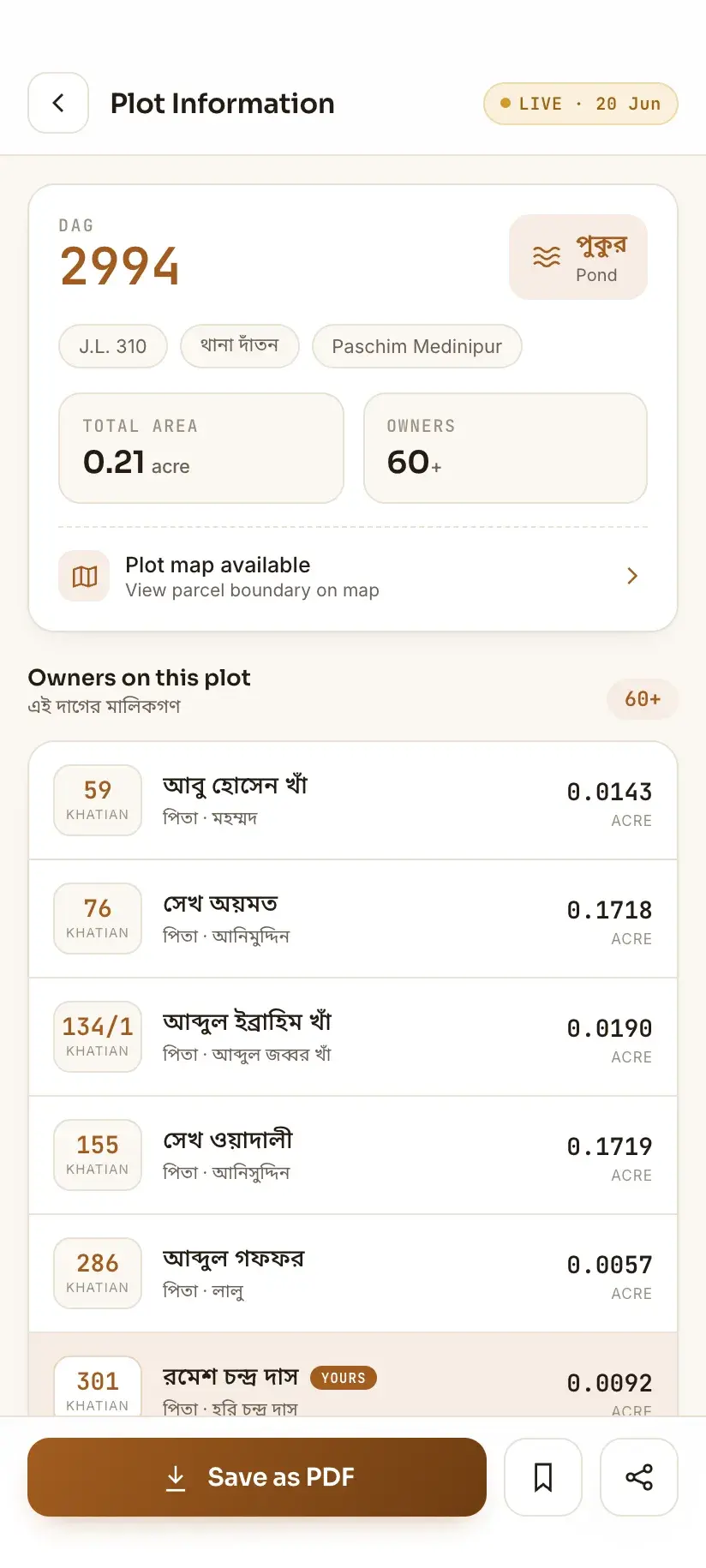
A share fraction is the most commonly misread field on the whole record. It expresses an undivided interest in the plot, not a marked-out portion of the ground.
Why the dag number alone is never enough
For any real purpose — a purchase, a loan, a boundary question — a dag number on its own carries too little information. To identify a plot unambiguously you need, at minimum, the District, the Block, the Mouza (with its JL number), the record generation the number belongs to, and the dag number itself.
Even with all of that, what you have read is a record, not a title. The record can be out of date because mutation was never completed, it can carry an error, and it says nothing about encumbrances such as a mortgage. An online plot lookup is a starting point for a verification, not the verification.
Nothing here is legal advice. Before buying land, lending against it, or acting in a dispute, engage an advocate who does land title work and confirm the position at the BL&LRO office for the relevant Block.
Looking up a dag number on Banglarbhumi
Plan on signing in. Know Your Property is the main search: choose District, Block and Mouza, then search by plot (dag) number or by khatian number. RS-LR Plot Information shows how a plot reads across record generations. Both are reachable from the menu while signed out, and the District, Block and Mouza dropdowns will populate for you — but the request that returns the plot detail is answered with the sign-in page. Register on banglarbhumi.gov.in first and the search completes.
If you are not certain which Mouza your land falls in, use Mouza Information before anything else. Requests for signed copies and maps — ROR Request, Plot Info. Request, Plot Map Request — sit under Service Delivery and also require you to be signed in.
Procedure
How to look up a dag number on the official portal
You will need a banglarbhumi.gov.in account. The dropdowns fill in without one, but the record itself only appears once you are signed in.
Open the official portal and sign in
Go to banglarbhumi.gov.in and sign in, registering first if you do not already have an account. You can browse the Citizen Services menu without signing in, but the search will stop short of showing you a record.
Choose Know Your Property
Select Know Your Property, the search for land records by khatian or plot number.
Select District, Block and Mouza
Work down the hierarchy in order. If you are unsure of the Mouza, check it first using Mouza Information — a dag number is only unique within a Mouza, so this selection determines whether your result means anything.
Search by plot number
Choose the plot (dag) search option and enter your dag number exactly as written on your document, without extra spaces or added prefixes.
Check the result against what you expect
Before reading further, confirm the owner name and recorded area are consistent with your documents. A result that looks unfamiliar usually means the wrong Mouza was selected, not that the record is wrong.
Read the record fields
Note the recorded holder, the share fraction if the land is jointly held, the area, the land classification, and the khatian number the plot sits under.
Cross-check across record generations
Use RS-LR Plot Information to see how the same plot reads in the other record generation. If your number came from an older document, expect the current number to differ.
Frequently asked questions
- What is a dag number in West Bengal land records?
- A dag number, also called a plot number, identifies one individual parcel of land as it was mapped and numbered during a survey. It corresponds to a specific bounded shape on the Mouza map, which is what links the written record to actual ground.
- Is a dag number unique across West Bengal?
- No. A dag number is only unique within a single Mouza. The same number exists in many Mouzas across the state, referring to completely unrelated plots. This is why every portal search asks for District, Block and Mouza before it will accept a plot number.
- What is the difference between a dag number and a khatian number?
- A dag is a piece of land; a khatian is a landholder's account within a Mouza. One khatian usually lists several dags, and a jointly held dag can appear under more than one khatian. Dag answers which land, khatian answers whose.
- What does the share fraction on a plot record mean?
- Where land is held jointly, the record shows each holder's share as a fraction — an undivided interest in the whole plot, not a marked-out portion of the ground. A half share does not identify which half. Dividing the land physically is a separate partition process.
- The owner name on the dag record is not the current owner — why?
- The record shows the recorded holder, which only updates when mutation is completed. If land was sold or inherited and the mutation was never applied for or is still pending, the earlier holder remains on record. The portal tracks pending applications under Mutation Case Status.
In Bengali
দাগ নম্বর কী — বাংলায়
পশ্চিমবঙ্গের জমির রেকর্ডে দাগ নম্বর হল একটি নির্দিষ্ট জমির খণ্ডের পরিচয়। বাংলারভূমি পোর্টালে দাগ নম্বর দিয়ে খুঁজতে গেলে আগে মৌজা বেছে নিতেই হয়।
- দাগ নম্বর মানে কী?
- দাগ নম্বর হল জরিপে চিহ্নিত একটি নির্দিষ্ট জমির খণ্ডের নম্বর। মৌজা ম্যাপে ওই নম্বরের একটি নির্দিষ্ট আকার ও সীমানা থাকে, তাই দাগ নম্বর কাগজের রেকর্ডকে বাস্তব জমির সঙ্গে যুক্ত করে।
- দাগ নম্বর কি সারা রাজ্যে আলাদা?
- না। দাগ নম্বর শুধুমাত্র একটি মৌজার মধ্যেই অনন্য। একই নম্বর পশ্চিমবঙ্গের বহু মৌজায় আছে, কিন্তু সেগুলি সম্পূর্ণ আলাদা জমি। তাই মৌজা ভুল হলে অন্য কারও জমির তথ্য দেখাতে পারে — মালিকের নাম ও জমির পরিমাণ মিলিয়ে নিন।
- দাগ আর খতিয়ানের পার্থক্য কী?
- দাগ হল জমির খণ্ড, আর খতিয়ান হল মৌজার মধ্যে কোনও ব্যক্তির জমির হিসাব। একটি খতিয়ানের অধীনে সাধারণত একাধিক দাগ থাকে। যৌথ মালিকানার ক্ষেত্রে একটি দাগ একাধিক খতিয়ানেও থাকতে পারে।
Related guides
- Mouza and JL number — the foundation of every land search
- Sabek dag to hal dag — matching old and new plot numbers
- How to search a Khatian online in West Bengal
- The Jomir Tothya app — what happened to it
- Land conversion in West Bengal — classification, application and status
- West Bengal land measurement units — katha, bigha, decimal, satak
- Bargadar records in West Bengal — what the record of rights shows